
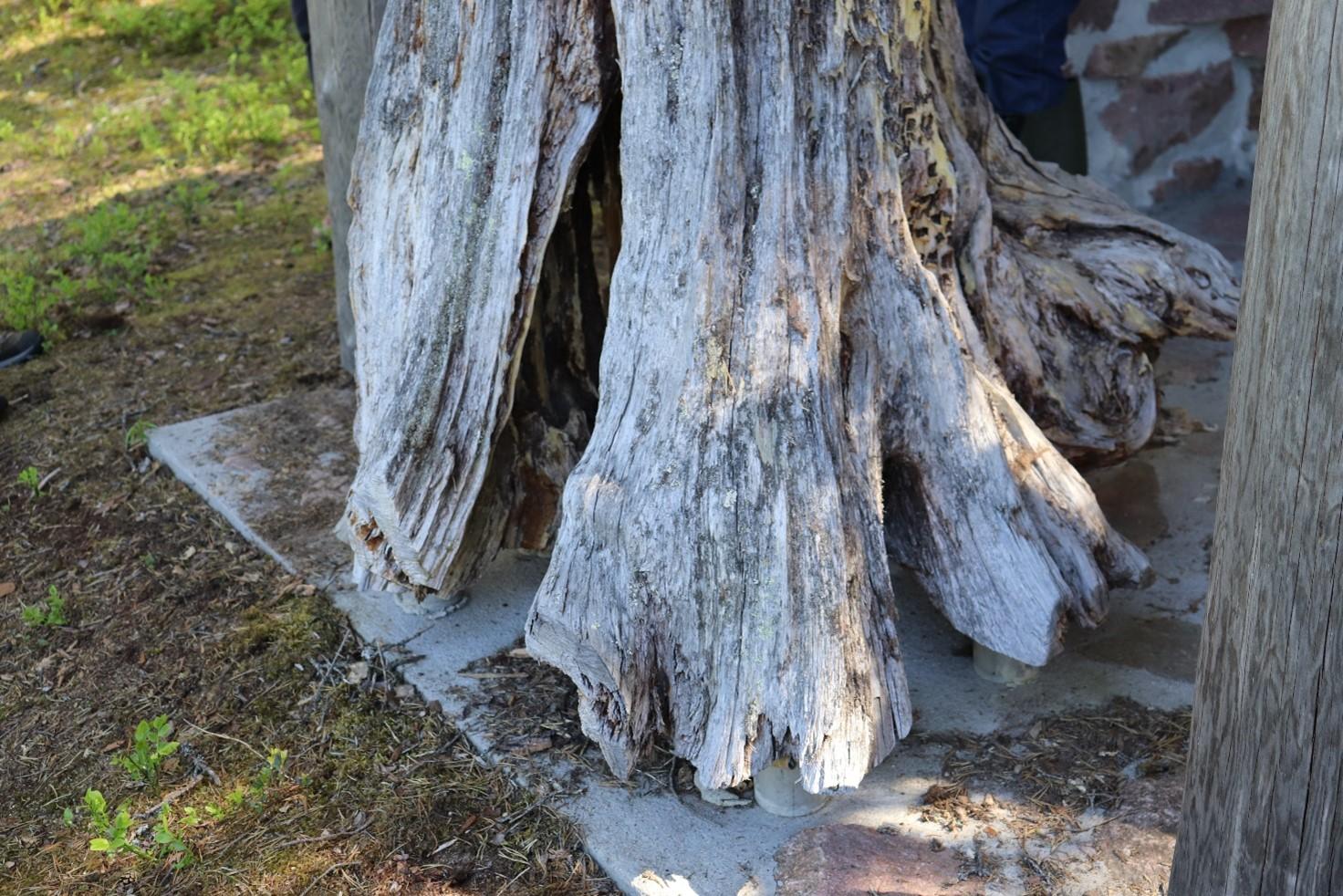
At the end of Tornionsärkkä, near Särkänpolvi, there is a marker tree named Satalatva. The Satalatva can be reached by walking along the Tornionsärkkä or by paddling the Porrasjoki.
The trunk of a multi-stemmed pine tree, classified as an ancient monument, is carved with two slits. The dates 1685 and 1787 are inscribed on them.
The Association of Kainuu commissioned a study at the University of Eastern Finland to determine the age of the tree and the time when the spots were made. It turned out that the tree started to grow at the turn of the 1500s and 1600s. The wood was carved with an axe in different years, the first in 1747 at the earliest and the second in 1769 at the earliest. The wood has grown for the first three hundred years and has matured over the last hundred years.
The bark fell about twenty years ago and was almost completely destroyed when it was partially buried in the Porrasjoki river. The root part of the tree was lifted under a log shelter built on the site in 2013.
The meaning of the tree is still a mystery. According to the National Board of Antiquities' Cultural Environment Register Portal, the Porrasjoki bark is located on the Vienan reitti but does not appear to be a marker for a passage route. The tree may be related to the boundaries, as the boundaries defined in the 1595 Peace of Täyssinä were ambiguous for almost a hundred years, and the boundaries may have lived on. The tree may also be a marker of the burial place of a significant person or a memorial tree, or a stump tree. Satalatva is also mentioned in the Kalevala poems.